Pentagon report on China sends clear security signal to India
The United States Department of Defense’s 2025 annual report on China’s military and security developments, though written for a domestic American audience, carries far-reaching implications for India’s strategic and defence planning.
The assessment underscores how China’s rapid military modernisation and evolving war-fighting doctrine are reshaping India’s security environment from the Himalayan border to the Indian Ocean.
At the heart of the report is the conclusion that Beijing is reconfiguring the People’s Liberation Army for high-intensity, multi-domain conflict against a powerful adversary, primarily the United States. However, the document makes clear that India cannot view itself as a peripheral concern. Chinese strategic thinking increasingly treats conflict as a continuum that spans grey-zone pressure, cyber and space operations, economic coercion and, if necessary, large-scale conventional war.
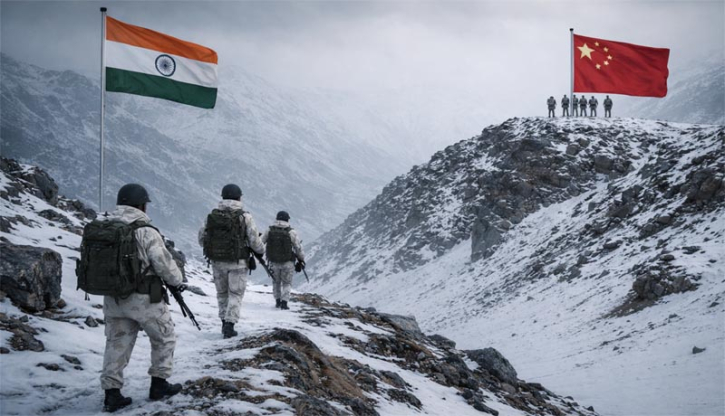
The report highlights PLA capabilities for long-range precision strikes extending up to 2,000 nautical miles, a range that allows China to shape crises beyond the Western Pacific. Combined with Beijing’s expansive claims over disputed territories, including Arunachal Pradesh, these capabilities create coercive options that could be applied against India during periods of tension along the Line of Actual Control.
A key concern for New Delhi is China’s fast-maturing command, control, communications, computers, intelligence, surveillance and reconnaissance network. Expanded satellite constellations, long-range sensors and data-sharing arrangements are enhancing Beijing’s ability to monitor developments across the Himalayas and the Indian Ocean, blurring the line between localised border standoffs and wider, multi-domain confrontations.
The report also flags China’s growing overseas logistics footprint, from Djibouti to Southeast Asia, and its expanding aircraft carrier programme, developments that compress the strategic distance between East Asia and the Indian Ocean Region. This reinforces Indian concerns about sustained PLA naval presence near critical sea lanes.
While the Pentagon assessment points to internal PLA challenges and transition risks, it leaves little doubt that India faces a more complex security landscape. Analysts say the report underlines the need for New Delhi to strengthen indigenous defence capabilities, deepen partnerships, and invest in cyber and space resilience, while remaining cautious in diplomatic engagement with Beijing.
.png "Advertisement")