2025 was the world's third-warmest year on record, scientists say
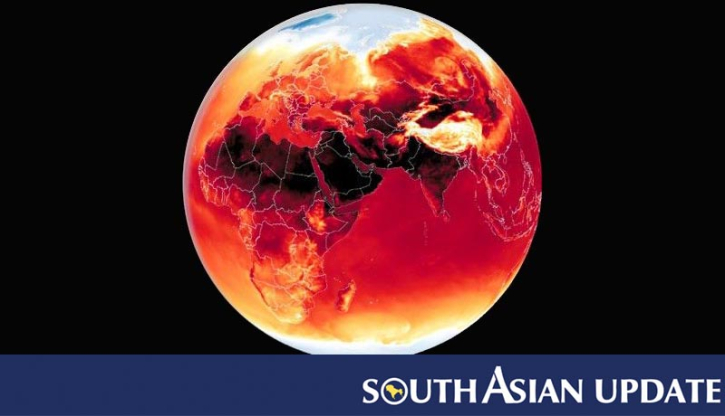
The year 2025 was the world’s third-warmest on record, capping an unprecedented run of extreme heat that has pushed global temperatures beyond key climate thresholds, European scientists said on Wednesday.
Data compiled by the European Centre for Medium-Range Weather Forecasts (ECMWF) showed that the past three years — 2023, 2024 and 2025 — were the hottest since modern records began, with 2025 only 0.01 degrees Celsius cooler than 2023. The UK Met Office independently confirmed the finding, ranking 2025 as the third-warmest year in records dating back to 1850, while the World Meteorological Organization is expected to release its own assessment later.
More significantly, scientists said the planet has now experienced its first three-year period in which average global temperatures remained 1.5 degrees Celsius above pre-industrial levels. That benchmark is widely viewed as a critical limit, beyond which climate impacts become more severe and harder to reverse.
ECMWF climate lead Samantha Burgess said breaching 1.5C should not be seen as a sudden tipping point, but warned that even small increases in temperature intensify extreme weather. She noted that higher heat has already translated into longer heatwaves, heavier rainfall and more destructive storms across regions.
Governments pledged under the 2015 Paris Agreement to keep long-term warming below 1.5C, but scientists now warn that this goal could be exceeded before 2030 due to continued high greenhouse gas emissions. Long-term global warming currently stands at about 1.4C, though short-term averages crossed the 1.5C mark in 2024.
The impacts in 2025 were stark. Europe recorded its highest-ever wildfire emissions, while studies linked climate change to devastating events including Hurricane Melissa in the Caribbean and deadly monsoon floods in Pakistan that killed more than 1,000 people.
Despite mounting evidence, climate science faces growing political resistance, even as researchers stress that human-driven fossil fuel emissions remain the primary driver of rising global temperatures.
.png "Advertisement")